


Laundry Business Investment
17th Jun 2026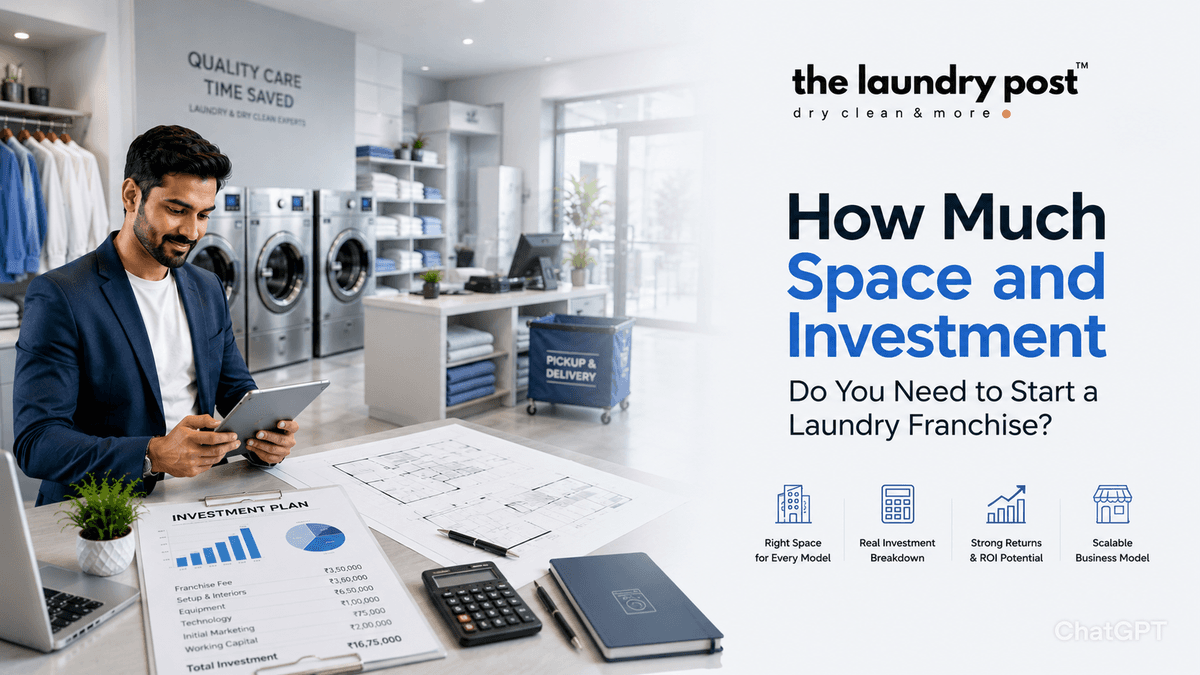
A reader named Karan wrote in recently. He runs a small electronics shop in Vadodara and wanted a second income stream, and had read through brochures from three laundry brands without getting a straight answer. One quote covered only the franchise fee. Another bundled in everything except rent. A third never mentioned space requirements until he asked.
That confusion is common. Most people researching laundry franchise opportunities expect one clean number, and what they get instead is a range that shifts with city, brand, and store format. If you read our earlier guide on starting a laundry business in India, you already know the franchise route sits at a different investment level than going independent. Here is exactly why, with real numbers attached.
Dual income households, smaller urban apartments, and professionals with no spare time on weekends have created steady demand for outsourced laundry, sharpened by a cultural shift around hygiene since the pandemic years.
Pickup and delivery models have widened that market further. A customer no longer needs to live near a shop to use one, which has opened residential pockets that were previously unviable for a standalone laundromat. This is part of why demand for professional laundry services has grown so fast, with established brands now actively expanding into Tier-2 cities where competition is thin and rent stays manageable.
Space needs depend more on format than on brand. A pickup-and-delivery-focused outlet, where most volume moves through a back-of-house processing area rather than a customer counter, can run comfortably in 250 to 400 square feet, which suits residential lanes and small commercial complexes where rent per square foot is high but footfall is not the main driver.
A full-service store with a counter and walk-in traffic usually needs 500 to 800 square feet for washing and drying equipment, a pressing station, garment racks, and a presentable front section. High-street locations with strong visibility expectations sometimes push past 1,000 square feet, mainly for signage and a more premium feel.
A 300 square foot unit inside a residential society in Ahmedabad can outperform a 700 square foot high-street store in a slower micro-market, simply because the customer base is already a short walk away and word of mouth travels faster within a society.
Franchise quotes rarely separate costs clearly, which is where most confusion starts. Here is a realistic breakdown for a mid-size city setup.- Franchise fee: Rs. 2 to 5 lakh, depending on brand positioning and territory exclusivity
Put together, a realistic total investment ranges from roughly Rs. 12 lakh on the lean end to Rs. 28 lakh for a larger, full-service format in a competitive metro. If a brochure quotes well outside that range, ask exactly what is and is not included.
City tier matters more than almost any other variable. A 500 square foot store in a Tier-1 metro can carry double the rent deposit of an identical store in Ahmedabad or Rajkot, and that gap compounds across every recurring expense in year one.
Equipment quality often matters more than store size. Two reliable mid-range machines with a service contract frequently outperform three budget machines needing repeated repairs early on. Your delivery model shapes the number too: a pickup-first business can work from a smaller, less visible unit and redirect rent savings into a delivery vehicle, while a walk-in-first model needs to spend more on location and signage. Brand positioning matters as well, since a premium dry cleaning brand expects higher finish quality in the interiors, which raises fit-out cost but supports higher per-order pricing.
Revenue depends on order volume and average order value, both shaped by location density and service mix. A well-located store in a city like Ahmedabad, running a mix of wash, fold, and dry cleaning, can realistically generate Rs. 1.5 to 4 lakh in monthly revenue once stable, though the first few months are usually slower.
Operating costs, including rent, staff, utilities, and consumables, typically run 50 to 65 percent of revenue for a well-managed outlet. Customer retention is what determines whether those numbers improve over time, since a loyal base that returns weekly is worth far more than constant churn chasing introductory discounts. Break-even commonly falls between 12 and 24 months, with franchise-backed stores tending toward the faster end since the operational mistakes have already been worked out by the brand. None of this is guaranteed, and any franchise promising a fixed return figure deserves closer questioning.
Underestimating working capital is the most frequent error. Owners budget for equipment and rent but forget the store needs several months to become self-sustaining, and that gap needs funded cash, not optimism. Choosing a location for personal convenience rather than customer density is another common trap; a store near your home is not automatically a store near your customers. Skipping the fine print on royalty structures and renewal terms is a mistake that usually surfaces later, once the original excitement has worn off.
Start with your actual budget, not the number you hope is enough. Walk the area you are considering and talk to a few residents about their current laundry habits before assuming demand exists. Think honestly about how operationally involved you want to be, since some formats suit owner-operators while others are built for investors hiring a manager from day one. And be clear about your growth goals, because a single store and a multi-unit territory call for very different levels of capital and attention.
If you are exploring laundry franchise opportunities and want a realistic sense of what the model looks like in practice, ask for a full cost breakdown rather than a single headline figure.
The honest answer to how much space and investment a laundry franchise needs is that it depends on the format you choose, the city you operate in, and how closely you read the fine print before signing. A 300 square foot residential unit and a 1,000 square foot high-street store solve different problems for different budgets, and neither is automatically the better choice. Before committing to any brand, ask for a clear breakdown of franchise fee, equipment cost, fit-out, and working capital, and weigh franchise support and the realism of the location plan more heavily than the lowest entry price. If you would like to talk through the numbers for your city, you can contact our team and we will walk you through what a realistic setup looks like for your situation.
A realistic total investment ranges from Rs. 12 lakh for a lean, pickup-focused setup to Rs. 28 lakh for a larger, full-service store in a metro city. The figure depends on franchise fee, equipment quality, store size, and city tier, so ask for a category-wise breakdown rather than one bundled number.
A back-of-house, pickup-and-delivery-focused outlet can run in as little as 250 to 400 square feet. Full-service stores with walk-in counters generally need 500 to 800 square feet, while high-street formats with strong visibility needs may require 1,000 square feet or more.
Yes, when location, service mix, and operations are managed well. Monthly revenue for an established outlet often falls between Rs. 1.5 and 4 lakh, with operating costs consuming 50 to 65 percent of that. Profitability builds steadily as repeat customers grow, rather than appearing right after launch.
Most franchise outlets recover their initial investment within 12 to 24 months. Stores with strong franchisor support, a well-chosen location, and consistent service quality tend to break even closer to the 12 to 18 month mark.
A standard setup needs commercial washing machines, matching dryers, steam ironing or pressing equipment, garment racks, and point-of-sale technology for order tracking. Equipment needs scale with store size and whether the format includes dry cleaning alongside regular wash and fold.
A laundry franchise is a serious investment, and the more clarity you have on space and numbers up front, the smoother that decision will be.
India's organized laundry market is still wide open, and the right franchise in the right city can be a genuinely solid bet for the next decade.