


FOFO vs COCO
20th Jun 2026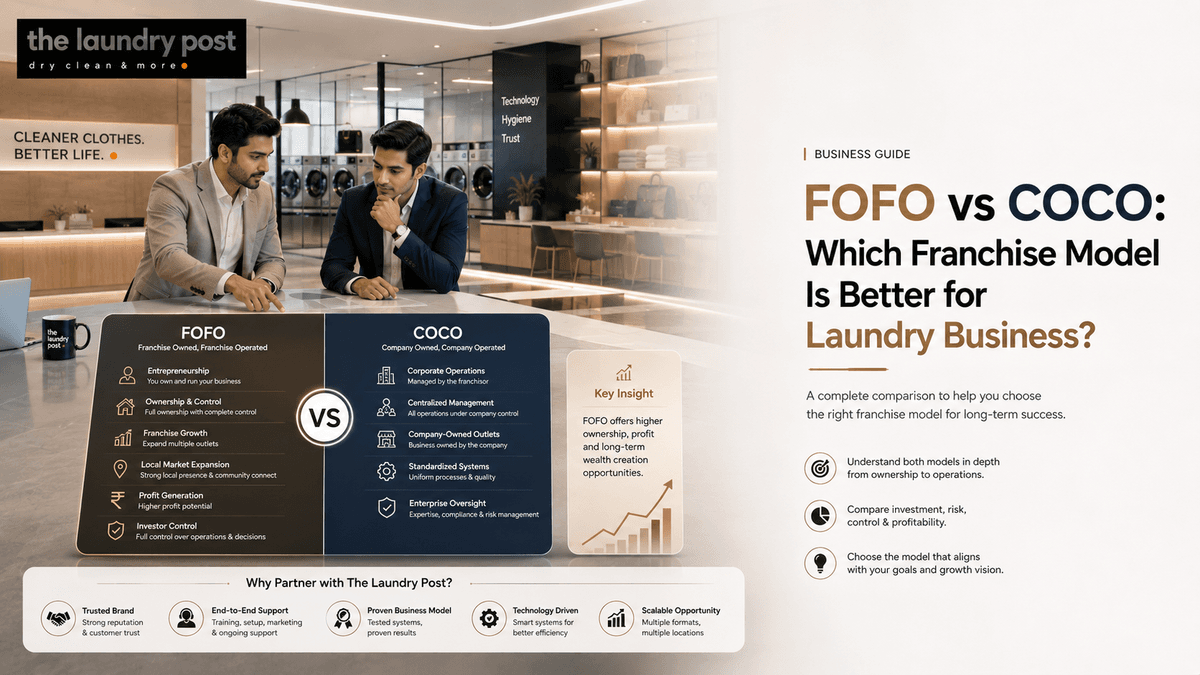
Priya had saved carefully for two years. She wanted to start a laundry business in Surat, had shortlisted a couple of brands, and was ready to sign. Then her chartered accountant asked one question she could not answer: "Are you signing a FOFO or a COCO agreement?"
She had no idea.
If you are in the same position, this article will give you a clear picture of both models before you commit a single rupee. The difference between FOFO and COCO is not just a naming convention. It changes who owns the outlet, who runs it, where the risk sits, and how much money you actually take home at the end of the month.
FOFO stands for Franchise Owned, Franchise Operated.
You put in the investment. You own the store. You handle the daily operations. The franchisor gives you the brand name, the operational systems, training, and ongoing support. In return, you pay a one-time franchise fee at the start and a monthly royalty, typically ranging from 5 to 10 percent of your revenue.
The FOFO model is the most common franchise structure in India, across food, retail, and service sectors. For a laundry business, it usually means you own the machinery, sign the lease on the premises, hire the staff, and manage everything that happens inside the store from opening to closing. The brand's job is to make sure you do it the right way through training and quality guidelines, not to send someone to manage your counter every morning.
This model works well for someone who wants ownership and is ready to be actively involved in the business. The upside is clear: after paying the royalty, the remaining profit belongs to you. If your store does well in a high-footfall residential area, your returns grow with it.
The challenge, which many first-time franchisees underestimate, is that operational responsibility sits entirely with you. Staffing problems, a bad month, or a location that turns out to be quieter than expected all of that lands in your lap. The brand advises. You solve it.
A good way to evaluate any FOFO opportunity before signing is to look at whether the franchisor offers a genuine support system or just hands you a manual and steps back. If you are exploring what a well-structured laundry franchise opportunity looks like in practice, reviewing what a franchise partnership genuinely includes is a useful starting point.
COCO stands for Company Owned, Company Operated.
Here, the company itself owns the outlet and runs it entirely through its own team. No external investor, no franchisee. The brand puts in the capital, employs the staff, and manages day-to-day operations directly.
From a service consistency standpoint, COCO outlets tend to perform more uniformly because every decision flows through the company. Staff follow company protocols directly, pricing is controlled centrally, and the customer experience does not vary based on how motivated (or stretched) a local franchisee happens to be that week.
In the laundry industry specifically, many established brands maintain COCO outlets in key cities for exactly this reason. They use them as quality benchmarks and as testing grounds before rolling out processes to their franchise network. It is similar to a parent brand cooking in its own kitchen before teaching the recipe to someone else.
The important thing to know if you are an investor: COCO is not open to you. You cannot buy into a COCO outlet. The company owns it entirely. If a laundry brand operates purely on COCO, there is no franchise opportunity on the table. What you sometimes see among larger brands is a hybrid approach, where COCO stores establish the brand standard in premium locations while FOFO expansion covers a wider geography.
If you want to understand the current demand for professional laundry services across different city types, the shift toward organised laundry in India tells you something important: both models are growing, but FOFO is where investor opportunity actually lives.
When you put both models side by side, the contrasts are clearer than most franchise brochures let on.
The core takeaway is straightforward: if you are looking to invest in a laundry franchise, FOFO is the model relevant to you. COCO is a company's internal expansion strategy, not a franchise offering.
Take Amit, a logistics professional in Ahmedabad who wanted a second income without leaving his job. He signed a FOFO agreement with an organised laundry brand, invested around Rs. 18 lakh covering fit-out and equipment, and hired a store manager to handle daily operations while he checked in remotely. By month eight, the store was pulling Rs. 2.2 lakh in monthly revenue. After a 7 percent royalty and his running costs, rent, wages, supplies, he was netting somewhere between Rs. 55,000 and Rs. 70,000 a month. Not life-changing on day one, but it was growing steadily as his subscription customer base built up.
Now compare that to how brands typically use the COCO model. When a premium laundry company enters a new city, say Jaipur, for the first time, they often open one company-owned store in a good residential pocket. The goal is not to make money on that store immediately. It is to prove the concept works in that market, iron out the operational kinks, and build some local brand recognition. Once that store is running well, the brand starts bringing in FOFO partners for expansion. The COCO store essentially becomes their proof of concept.
Meera saw exactly this play out in her favour. Her first FOFO laundry store in Vadodara broke even in fourteen months. When she approached the brand about a second unit nearby, they offered her a lower franchise fee because she was an existing franchisee who already knew the system. By the end of her second year, both stores together were generating around Rs. 1.2 lakh in monthly profit. She did not need a new playbook for the second store. She just needed a better location and the lessons she had already learned the hard way.
None of this is drawn from a market research report. These are realistic outcomes when the location is right, the brand genuinely supports its franchisees, and the owner stays involved.
For broader context on how the organised laundry sector is developing across different service types, the laundry business insights section covers a range of practical topics without the typical franchise sales pitch.
The honest answer is that the right model depends entirely on who you are.
If you are an individual investor who wants to own a business, generate personal income, and build equity in something you can later sell or pass on, FOFO is your model. It is where the franchise opportunity exists for outside investors, and when operated well, it offers meaningful returns in a sector with genuine long-term demand. The laundry industry in India remains overwhelmingly unorganised, which means organised franchise players are still in the early stages of capturing market share. Getting in now, in a well-chosen city and neighbourhood, carries real strategic value.
If you are a brand or a company looking to maintain tight quality control while building a presence in specific premium markets, COCO gives you complete consistency. You do not share your margin. You do not depend on a franchisee to represent your brand correctly. But you also carry every rupee of risk and every operational headache yourself, across every outlet.
For most people reading this, the choice is FOFO. What actually matters is not the model label, it is the franchisor behind it. A FOFO agreement with a brand that gives you real support, a working CRM, proper staff training, and an honest territory, is worth far more than a cheaper agreement with a brand that disappears after onboarding.
If you want to understand what a franchise partnership looks like on ground level before you decide, it is worth taking the time to speak to the team directly and ask the questions that brochures rarely answer.
In the FOFO (Franchise Owned, Franchise Operated) model, an independent investor owns and runs the outlet under the brand's systems. In the COCO (Company Owned, Company Operated) model, the brand itself owns and operates the store with no external franchisee involved. FOFO is available to outside investors; COCO is not.
For an individual investor, FOFO is the relevant model since COCO outlets are not open to outside investors. FOFO gives you ownership, profit rights, and the ability to scale to multiple units. Whether it performs well depends on your location, your level of operational involvement, and the quality of support your franchisor provides.
FOFO requires the franchisee to invest their own capital, typically ranging from Rs. 12 to 28 lakh for a laundry franchise depending on the brand, city, and store format. COCO stores are funded entirely by the company, so no external investment is involved. As an investor, FOFO is the model where your money goes in.
Yes. Many first-time business owners start with a FOFO laundry franchise precisely because the brand provides a tested system, training, and operational guidance. You do not need to build processes from scratch. However, you do need to be actively involved, choose your location carefully, and select a brand that offers genuine post-launch support, not just an onboarding package.
FOFO gives the franchisee full control over daily operations, including staff hiring, local marketing decisions, and store management. The franchisor sets brand standards, but operational decisions are yours. COCO, by contrast, keeps all control with the company. If control and ownership matter to you as an investor, FOFO is the model that delivers both.
Still unsure which model fits how you want to build?
Stop guessing — your business goals deserve a model that's built around them, not the other way around.